C-Box 3
High-end in the backpack.

Klein aber Oho!
Die gerade einmal 20cm hohe C-Box 3 ist wohl der kleinste Mastering Lautsprecher, der jemals gebaut wurde.
Fully analog
Analog enthusiasts can look forward to the completely analog signal processing from the signal input to the eardrum.
Active
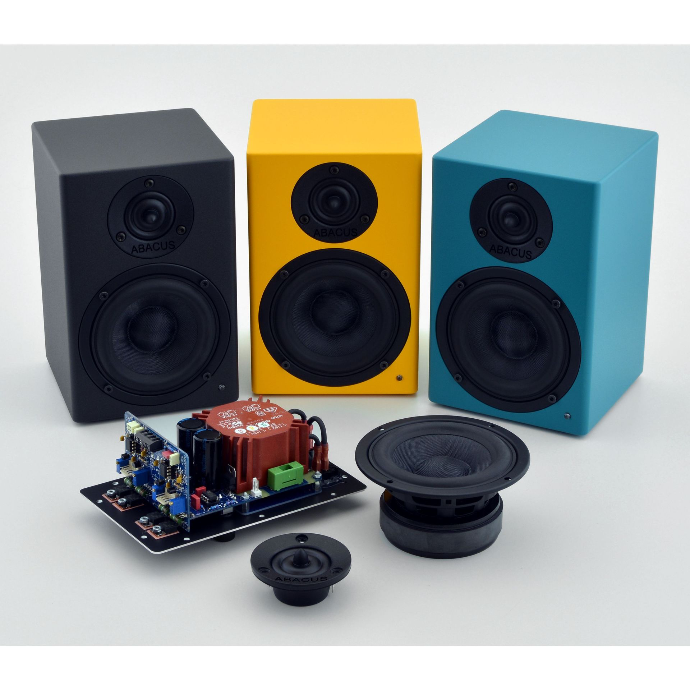
Thanks to the integrated ABACUS Dolifet amplifier.
Ultra-Nahfeld
The C-Box is physically designed for the ultra-near field (< 1m listening distance). A greater listening distance is recommended with the addition of a subwoofer..
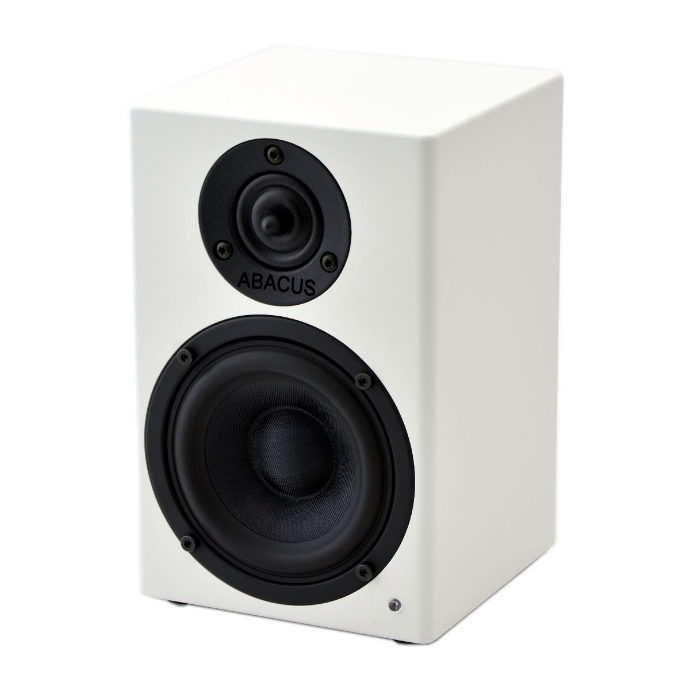
Hi-Fi or Studio:
35 - 20.000Hz
linear
(-6dB at lower cutoff frequency)
Customizable to any situation
Mounting on tripod, ceiling, or wall - and in colorful.
Handcrafted in Germany
25W RMS
Enough power for small studio monitoring in ultra nearfield.
Sounds too good to be true?
Here you will find the ABACUS lexicon, which will likely answer your burning questions:
The exceptionally deep bass reproduction of the ABACUS speakers is based on the interplay of several technical principles that are unique in this form. The key is the combination of the load-independent DOLIFET amplifier technology (Drain Output Load Independent Field Effect Transistor), the closed cabinet design, and a precisely tuned electronic bass equalization.
Basic Idea and Objectives
The DOLIFET principle (Drain Output Load Independent Field Effect Transistor) is a power amplifier concept developed by ABACUS, designed for maximum load independence, high linearity, and precise control of output voltage and output current. It is based on the realization that the electroacoustic interface between the amplifier and the loudspeaker – that is, the voice coil – cannot be considered an ideal resistive load, but rather exhibits complex, frequency-dependent, and reactive behavior in practice.
Conventional amplifiers, particularly classic emitter configurations (in bipolar transistors) or source follower topologies (in MOSFETs), operate with a low internal voltage gain in the output transistor and therefore have only a limited regulation margin against varying load impedances. DOLIFET aims to completely eliminate this dependency, allowing the amplifier to reproduce the exact same output voltage regardless of the connected load, just as it does in an unloaded state.
Drain output and overall feedback
The central distinguishing feature of the DOLIFET principle is the arrangement of the speaker at the drain output of the power transistor – not, as is common in conventional concepts, at the source or emitter.
As a result, the full voltage gain of the transistor is in the control loop. In conjunction with an overall feedback across all amplifier stages, this results in an extremely low effective output impedance, typically in the range of a few milliohms.
This arrangement results in behavior that closely resembles that of an ideal voltage source: The amplifier enforces the desired voltage at the output regardless of the load impedance and delivers or absorbs the corresponding current precisely according to the input signal. Even with highly inductive or capacitive loads, the output remains phase and amplitude stable.
Four-Quadrant Work Method
Another feature of the DOLIFET principle is the four-quadrant capability. The amplifier is not only able to deliver electrical energy to the load (first and third quadrants), but it can also actively absorb and control backflow energy – such as from the counter-EMF of a speaker – and return it to the power supply circuit (second and fourth quadrants).
This behavior enables an active damping of the speaker diaphragm: As soon as the signal decays or the diaphragm rebounds due to its inertia, the amplifier does not passively brake, but instead actively dissipates the return currents and keeps the diaphragm precisely at the target position. This results in an exceptionally controlled, vibration-free motion behavior of the transducer – even at very low frequencies.
Stability, low distortion, and dynamics
Through the drain output topology and the extensive feedback, an extraordinarily high loop gain is achieved well into the audio frequency range. This results in minimal distortion, an exact phase relationship between the input and output signals, and an almost ideal transfer function.
Even with low-impedance, complex, or varying loads, the amplifier remains completely stable – a behavior that is typically only achieved within narrow operating conditions in conventional power amplifiers.
The linearity of the DOLIFET principle also allows for the optimal utilization of the entire operating point range of the power transistor. Since the amplifier is actively feedback-capable, it can handle high pulse power without entering saturation or clipping. The result is an exceptionally dynamic, pulse-stable, and phase-pure behavior.
Application in external amplifiers
IIn classic HiFi and studio amplifiers, the DOLIFET principle enables an almost perfect coupling to any speaker load. Even problematic impedance curves or highly reactive speaker designs do not affect linearity or stability. The amplifier behaves electrically as if it is always driving an ideal resistance, regardless of whether the actual load is 2 Ω, 16 Ω, or complex with phase shifts.
This leads to an outstanding damping factor and an acoustically perceptible improvement in bass precision, dynamic response, and spatial imaging. Even under high power demands, the behavior remains precisely reproducible and free from nonlinear load interactions.
Integration in active speakers and subwoofers
Especially impressive is the potential of the DOLIFET principle when it is directly integrated into active speaker systems. Here, the amplifier control can be specifically tailored to the electroacoustic properties of the chassis and the enclosure.
In combination with electronic equalization – whether digital in the DSP or analog through frequency-dependent mixing filters – the DOLIFET amplifier allows for complete control of the diaphragm movement down to below the system resonance frequency.
This allows the natural deep bass drop to be electronically compensated without instability, ringing, or distortion occurring.
The result is active speakers and subwoofers with real deep bass capability well below 20 Hz, whose low-frequency reproduction is not limited by the usual interactions between the speaker and amplifier. The amplifier remains phase-stable, low-distortion, and precisely controlled in every operating state—even at high currents or feedback currents from the speaker.
Summary
The DOLIFET principle represents a consistent advancement of classical amplifier technology. By utilizing the drain output, comprehensive feedback, and four-quadrant operation, an amplifier is created that behaves electrically like an ideal voltage source and mechanically allows for precise control over the loudspeaker system.
In external amplifiers, this results in outstanding neutrality, stability, and bass precision – in active systems, it additionally leads to an unprecedented deep bass reproduction and overall linearity.
In order for the control to be implemented acoustically, all ABACUS speakers use closed enclosures. This design results in a gentle level drop of only 12 dB per octave below the resonance frequency and avoids the typical resonance peaks of bass reflex or passive membrane-based systems. The resulting deep bass loss is electronically compensated.
Depending on the model, the equalization is done digitally or analogically.
In DSP-based systems, the natural deep bass roll-off is compensated by calculated equalizer filters, whose parameters ensure linearity across the entire transmission range – without resonances or phase errors.
Analog models use multi-stage filter circuits that overlay first and second order low-pass filters with differently weighted portions of the original signal. This creates a stable, phase-correct compensation of the roll-off that operates without oscillations or overshoot.
The C-Box series uses a simplified variant with a second-order low-pass filter. In the larger studio and high-end models, first and second-order filters are combined, allowing for more precise and deeper equalization.
The DOLIFET amplifier ensures that the equalized signal form is actually realized at the speaker's voice coil. Due to its high current delivery capability, its four-quadrant capability, and its complete load independence, the relationship between electrical control and mechanical movement remains precisely intact. In this way, a linear frequency response is achieved up to the threshold of audibility, without phase shifts or temporal blurring.
The maximum possible sound pressure in the deep bass is limited by the mechanical load capacity of the speaker – large displacements are only possible in a certain ratio to achievable levels. In practice, however, this is rarely relevant, as music in the sub-bass seldom contains the same level as mid or high-frequency components. What matters is the correct ratio of the low frequencies to the overall sound – this is precisely what the ABACUS principle ensures, allowing even compact speakers to achieve a large and complete reproduction.
To adapt to space, application, or personal preferences, each model has an adjustable high-pass filter that allows for the setting of the lower cutoff frequency and thus the level reserve.